My sister is obese. She's been going to the gym with me for the past 8 months and she's doing great except for one thing: she's not losing weight. She's getting stronger but the scale ain't moving. The obvious culprit is her diet. If you're not eating at a caloric deficit you won't lose weight.
She understands that the scale isn't moving because of what and how much she eats, but her behaviour hasn't changed. I don't know why. I can't look inside my sister's mind. She could have an eating disorder for all I know. Her diet is something we discuss only occasionally.
I want to be abundantly clear. The only way to lose weight is to be at a caloric deficit. Every diet out there achieves this one way or another. There is no magic. Some achieve it by limiting when they eat (i.e. intermittent fasting), others by limiting what they eat (e.g. Paleo Diet).
The end result is the same: a caloric deficit. Studies have shown that people who are too fat drastically underestimate the caloric content of the foods they eat by as much as 50%. That means that when they think they've only eaten 1200kcal they've actually eaten twice as much.
All I want from you is to be aware that your behaviour over the past decades is the reason you're fat and that changing it is no easy task. There are rare exceptions (e.g. thyroid issues), if you suspect an underlying medical reason, see a doctor.
The takeaway here is that the psychology behind eating is complex and that each individual is unique. I can teach you how I go about it, but that doesn't mean you will succeed if you follow "my way". All I've got is a messy and boring solution.
I like data and excel sheets, so here's an excerpt of one. There's no need to squint your eyes to look at the sheet, just read on.

Each row lists a food item with the following data recorded:
- grams/ml
- "factor" (how much of it I eat expressed as a growth factor)
- calories per 100 gram (info listed on the back of the food items I purchase)
- fat per 100 gram
- carbs per 100 gram
- protein per 100 gram
- empty column
- consumed (total calories per item expressed as a "factor" multiplied by the "calories per 100" column)
- fat ("factor" multiplied by "fat per 100gr" column)
- carbs ("factor" multiplied by "carbs per 100gr" column)
- protein ("factor" multiplied by "protein per 100gr" column)
- checkmark column
The "factor" column lets me easily adjust the amount I eat without touching anything else.
If I eat 70 grams of something I list 0.7 as the factor. If I eat 130 grams of something I list 1.3 and so on.
The appropriate columns update automatically. The checkmark column lets me flag "this is what I ate today". The formula at the bottom of the page sums up everything that was flagged.
At the bottom of this sheet I list the total calories consumed:
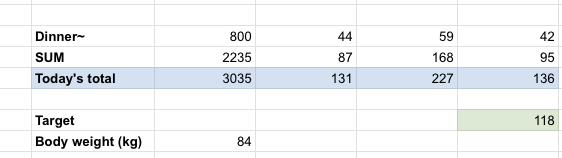
Then on a different sheet I log my calories and protein for today. It's on the same sheet where I record my weight and waist along with 5-day rolling averages for weight, waist, calories, and protein intake. This lets me determine my intake, weight, and waist measurements more precisely.

Over time this gives me incredibly powerful data to act on.
Tracking breakfast, lunch and snacks is fairly straightforward because only a few ingredients are involved, but when it comes to dinner it's an absolute mess. It's stupid easy to underestimate the amount of cooking oil in your meal. Logging dinner drove me mad, so I came up with a messy solution.
I ballpark dinner at about 800kcal. And this is risky as fuck. I know from experience by eating HelloFresh dinners that the average is about 600kcal for a standard adult meal. So I figured that 800kcal would account for a significant margin of error. Turns out that tracking the 80% correctly and estimating the remaining 20% works quite well!
After 21 days I learned that my maintenance weight is somewhere between 2500 and 2600kcal, probably closer to 2600. Filling out the sheet takes about 2 to 3 minutes per day. And to me it's less painful than opening an app. I leave it open on my desktop computer which I need to use every day anyway.
Now I can steer my weight by either eating one less snack or increase my weight by eating one more. I've done the boring task of tracking and I've accounted for the messy nature of eating and somehow this translated into actionable data. This is the only guaranteed way of learning how to control your diet.
If the scale isn't moving despite all your hard work then it's likely you need therapy. I can't stop you from opening a bag of chips and consuming it in one go. I see my sister do this and then she just doesn't stop. The whole bag disappears in one sitting, or half a bag. Then she moves on to M&M's or something else. And it rarely ends there. She knows this is why she is fat. She knows it's a health risk. She does it anyway.
The whole point is to not judge her for it. What's driving her to do this? Does she do it out of boredom? Is she trying to meet an emotional need? I don't know. She's in therapy to figure this out on her own. My only job as her brother is to keep encouraging her to exercise and celebrate her wins.
The best diet advice out there: eat a varied high-fiber diet of nuts, seeds, legumes, protein, fruits and vegetables, healthy fats and enough carbs to suit your needs. Emphasis on varied. That's it, really, as far as your health is concerned. But you can overeat on healthy foods too, which sucks!
Dieting is hard work. It's stupid hard work! So please don't go at it alone. My sister has me for support, and her boyfriend, and her therapist, and my parents. That's a solid support network. The statistics are crazy for diet adherence. Only about 1 in 200 obese people manage to lose weight long-term.
Go easy on yourself and find your people, build a system that works for you, and adjust as necessary.