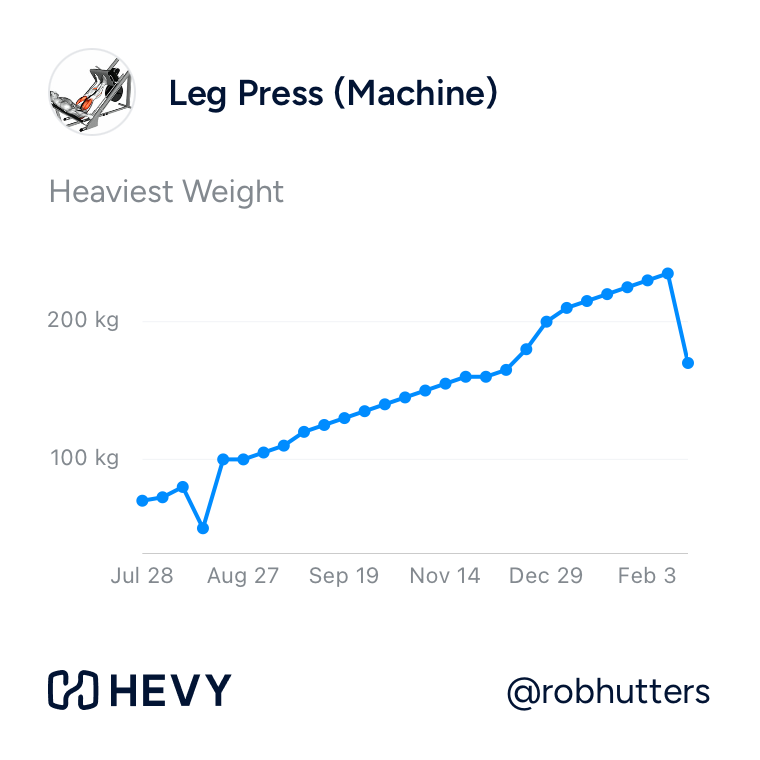
The above encapsulates everything you need to know about my fitness philosophy. I started at 70kg and added a little bit more weight every week until I hit 235kg between July 28th and February 3rd. That's 7 months worth of insane progress. Muscles do not grow unless you're doing exactly this.
The reality is a bit more nuanced. You do not necessarily need to increase the weight week by week. You could instead increase volume. Volume is reps multiplied by sets multiplied by weight. For example: 2 sets, 10 reps each set, at 80kg would give you 1600kg worth of volume. If you do 2000kg the next week you would send the same signal to your body: muscle growth. The key insight here is that you need to do progressively more work.
People really seem to struggle with what "progressively more work" actually means in practice. It doesn't mean you push yourself to failure every time you go to the gym. That's a recipe for injury and flunking out. It means you need to deliberately add a little bit more work to your workouts every week.
A system that works
I train my sister. She's been going with me for 24 weeks now. It took her until last week to finally learn how to progress without input from me. She's not dumb. She has a masters degree in psychology. And yet she still checks in with me to ask how much work she should be doing. The system is simple.
You don't need to do more than 2 sets per exercise when you're just starting out. You only start adding sets when the work you're doing is no longer sufficient. But when is that?
I tell her to aim between 8 and 12 reps for each exercise. If she hits 8 but can't really go on any longer than that means she's working with the correct weight. It's not too heavy, not too light.
If she's capable of doing 12 reps it's time to move up a weight. When you go up a weight your target range changes. You need to develop new strength. Your target should be between 3 to 5 reps.
If can do 3 now, you should hope to be able to do 5 next week. If you can manage that you know that you've been sleeping and eating well enough. Once you've hit 5 you can start working towards 8.
You add a set when you hit a strength wall. If you struggle to go up in weight, it's time to measure work in terms of volume instead.
It's really that simple. And most importantly, it works.
What does it mean to 'train to failure'?
If you're doing 8 reps and you're thinking "I can't make it 12", you're failing. You should quit. Even IF you can still squeeze out maybe 2 or 3 more, you should quit. Training to failure shouldn't mean "completely exhausting the muscle". It simply means that you've done more work than last week and that you're reaching the limits of what you're capable of. Aim for a healthy margin for two reasons.
-
You don't want to exhaust yourself so badly that you can't do other things life demands of you. You don't have the time to sleep during the day to recover from your workout. You don't want to start hate living because your muscles are so sore you can't do anything but rest.
-
It'll keep you injury-free. You'll be able to make steady progress for at least 3 years before you need to start thinking about changing your approach a bit.
Why I don't take progress photos
My sister recently told me that her pants feel looser. The only logical conclusion here is that she's gotten smaller. That's excellent progress. And yet, it sent her spiralling. She started comparing herself to other people. She thinks she should be losing much more weight much more quickly. Comparison is what's killing her motivation to work out. I told her she should stay focused on the only numbers that matter.
There are dozens of variables at play here. There is no telling which ones are preventing her from losing weight on the scale. We can make educated guesses, but I am of the opinion that you shouldn't. Because in the end it is not going to change the work you need to be doing.
Especially in the first year, you want numbers to tell you what's actually going on. The weight on the scale doesn't tell anything but your relationship to gravity. That's it. And scales that measure muscle mass and the like are unreliable. You'd need a DEXA scan to get anything close to reliable data. You'd need to go to a hospital or a clinic.
There's no need for that. Her weight won't change much until she starts addressing her steady diet of junk food and sugary snacks. She's seeing specialists for that part of her health journey.
A progress picture can't give you the data you need to base your decisions on. Let's say that your body is visually changing, that could be an indicator of success, but you're not in control at all. You're just guessing, and you just happened to guess just right enough to see a change, but you will hit a wall eventually and won't know what to do then.
The only two questions you need to ask yourself:
- How do my clothes fit?
- Am I pushing a bit more weight each week?
If you're tracking your numbers right, you'll have clear answers to both. For me, my clothes are starting to become too tight, and as a skinny guy, that's great news! It means my body is growing. I know it is growing because I track growth numbers for every body part in an Excel sheet. But when you're just starting out you don't need to do this. How your clothes fit is a strong enough indicator.
I measure total volume for my sister's workouts and the weight that's been pushing. Total volume has gone up from 1500kg all the way to 5500+kg in as little as 24 weeks of work with just ONE gym session per week. That's crazy progress. Her seated shoulder press went up from 1.25kg per arm to 11.25kg. An 800% increase! Stellar! She's growing strong and her clothes are starting to become too large. There are no better indicators of progress.
Take one progress picture at the start of your journey if you want, but there's no need to take another until you're at least a year into your fitness journey. Most people never get there. Progress pictures can't give you the data you need to base decisions on. Measure what actually matters and you'll stay motivated.